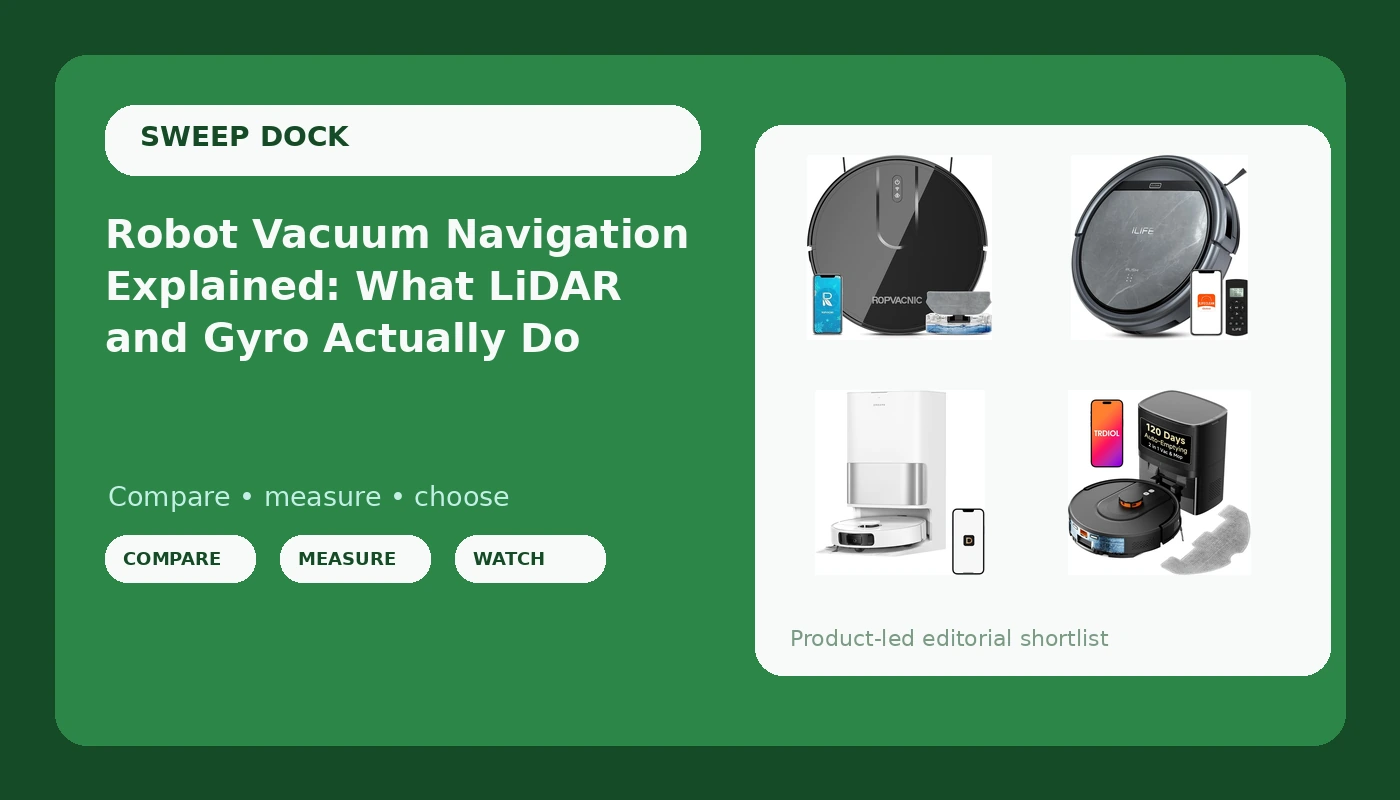
A robot vacuum is a maintenance tool, not a replacement for your real vacuum, and the spec that decides whether it feels like a tool or a chore is robot vacuum navigation. Suction numbers sell boxes. Navigation decides whether the thing finishes the kitchen, finds the hallway, and gets back to its dock from the back bedroom instead of dying under the sofa table. I have watched a random-navigation bot bump the same wall three times in a single run, which is why every recommendation below starts with how a model moves through a floor plan, not with a big number printed on the box. This guide walks through four current options at four very different price positions, explains what gyro and LiDAR mapping really do, and covers the parts people forget to budget: dock maintenance, mopping limits, and how much babysitting you are signing up for.
Related: Robot Vacuum Suction Ratings: What Pa Numbers Actually Mean →
Quick answer
Buy for navigation first, suction second, and convenience third. If you want a robot you can schedule and genuinely ignore for weeks, choose a model with LiDAR mapping, no-go zones, and a self-emptying dock, which is what the 120-day self-emptying Robot Vacuum and Mop delivers. If your budget sits lower, a gyro-assisted or simpler bot with strong suction can still handle a small floor, but plan on being home while it runs and on pulling it off a cord now and then. None of these replace a full-size vacuum, and none of them deep clean a floor.
Four useful options at four price positions
| Model | Best fit | What stands out |
|---|---|---|
| ILIFE V5s Max Robot Vacuum, 4000Pa Strong Suction, Gyro Navigation | Small apartments and single rooms on a tight budget | Gyro navigation and 4000Pa suction in the entry tier |
| ROPVACNIC Robot Vacuum and Mop Combo 5200Pa Suction Robotic Cleaner | Pet hair cleanup on a tight budget | 5200Pa suction plus a mop combo at the value end |
| Robot Vacuum and Mop, 120-Day Self-Emptying with 6000Pa Suction, LiDAR Navigation & Smart Mapping & No-Go Zones, Anti-Tangle, for Pet Hair, Carpets and Hard Floor | Long stretches between bin empties with mapped, fenced cleaning | 6000Pa suction, LiDAR mapping, no-go zones, and a 120-day self-emptying dock |
| dreame D30 Ultra CE Robot Vacuum and Mop, 25,000Pa Powerful Suction | High-traffic floors and carpets where suction is the priority | 25,000Pa suction in a vacuum and mop combo |
The entry point: ILIFE V5s Max Robot Vacuum, 4000Pa Strong Suction, Gyro Navigation
Gyro navigation is a real step up from the cheapest random-navigation bots. Instead of bouncing until it happens to cover ground, the robot uses an internal gyroscope to track heading and keep passes straighter, which matters more than most shoppers expect on an open living room floor. What it does not give you is a map. There are no no-go zones, no room-by-room scheduling, and no precise dock-finding route from the far end of the house. In practice that means you clear the floor before a run, you keep the area modest, and you accept that the bin fills fast if you have shedding pets. The trade you are making is straightforward: you spend less, and you spend more attention.
The value pet-hair pick: ROPVACNIC Robot Vacuum and Mop Combo 5200Pa Suction Robotic Cleaner
Here is the honest part about pet hair: suction helps, but the bin and the brush matter just as much. A 5200Pa robot will lift a surprising amount of husky and lab coat off a hard floor, and if it can do that without wrapping hair around the roller, you will notice it. What this class of robot will not do is map your house. There is no LiDAR here, so you should expect wall bumps, some repeated coverage, and the occasional cord tangle. That is the trade at this price position, and it is a fair one if your main floor is not enormous. Mop function on this tier is light maintenance. It handles the dusty film that builds up over a day, not dried-on anything.
The self-emptying LiDAR pick: Robot Vacuum and Mop, 120-Day Self-Emptying with 6000Pa Suction, LiDAR Navigation & Smart Mapping & No-Go Zones, Anti-Tangle, for Pet Hair, Carpets and Hard Floor
This is the model where the robot vacuum stops being a toy you follow around. LiDAR navigation builds a map of your floor, which unlocks three things that change daily life: the robot can run in orderly passes instead of guessing, you can fence off the areas you do not want it to touch, and it can plan a route back to the dock from the far end of the house. Add a dock that holds weeks of debris and the chore drops from daily to occasional. Two caveats worth stating plainly. A self-emptying dock is convenience, not freedom, because the filter, the brushes, and the dock bag still need attention on a schedule. And 6000Pa is respectable without being the highest number on this page, so if your priority is maximum suction on carpet, read the next section before deciding.
The high-suction option: dreame D30 Ultra CE Robot Vacuum and Mop, 25,000Pa Powerful Suction
Suction numbers on a spec sheet are not the whole story, but the gap between 6000Pa and 25,000Pa is wide enough to matter on carpet, where grit works its way down into the pile. If you have a low-pile bedroom carpet and a dog that sheds year round, more suction plus a good brush roll is what pulls hair out of the fibers instead of skating over them. The trade is price position and expectations. This sits at the premium end of the four, and it is a vacuum and mop combo rather than a full replacement system, which means the same rule applies as everywhere else on this page: it keeps the floor maintained between your real vacuuming sessions. Read the current listing carefully for what is included with the CE variant before you buy.
Prices and availability may change. Product images, names, and retailer links must be matched by verified ASIN. Do not state a current price, rating, stock status, or measured result without current evidence.
How navigation changes what you babysit
There are three broad levels of navigation, and they explain almost every difference in how much work a robot adds to your day.
Random navigation is the oldest and simplest. The robot moves until it hits something, turns, and carries on. Coverage is uneven, some corners get swept three times, and other spots never see the brush. This is the mode that produces the classic complaint about robots that "go in circles."
Gyro navigation, which the ILIFE V5s Max uses, adds an internal gyroscope that tracks direction and heading. Passes get straighter, coverage gets more even, and the robot spends less time re-covering ground. It still has no idea where it is relative to a map, so it cannot follow a route, cannot remember a room, and cannot be told to skip one.
LiDAR navigation, which the self-emptying Robot Vacuum and Mop uses, sends out laser pulses to measure distances and build a floor plan. That map is what makes everything else possible: room-by-room cleaning, defined no-go zones around pet bowls and cable piles, barrier strips in the app, and a planned return to the dock.
The most underrated part of that list is the last one. A robot that cleans a room beautifully and then dies two feet from its dock is still a robot you have to fetch. Ask yourself where the dock will live and how far the farthest room is from it, because a real dock-finding run from the back bedroom is a better predictor of daily satisfaction than any suction figure.
What self-emptying docks and mopping actually do
A self-emptying dock pulls the contents of the robot's bin into a larger bag or canister in the base. The 120-day rating on the model above refers to how long that dock capacity is expected to last, not to a robot you never touch. Filters still load up. Brush rolls still collect hair. Docks with bags still need bags. The convenience is real, especially in a shedding household where a small onboard bin fills in a single pass, but it is convenience, not a maintenance-free system.
Robot mopping is the other place where marketing outruns reality. A mop pad dragged behind a robot applies light moisture and picks up dust film and fresh footprints. It does not scrub dried-on spills, it does not agitate a stain, and on every one of these models it works better as a follow-up to a vacuum pass than as a standalone deep clean. If you want the kitchen floor to actually sparkle, you will still own a mop. Where the robot helps is frequency: a pass every day beats a thorough hand mop once a week for keeping a floor looking maintained.
A repeatable way to decide:
- Measure your main floor and the distance from the farthest room to where the dock will sit.
- Count the clutter that lives on the floor daily, including pet bowls, cords, and rug edges.
- Decide whether you need a map. If you want no-go zones or room scheduling, you need LiDAR.
- Decide how often you are willing to empty a bin. Daily emptying points to a self-emptying dock.
- Set your ceiling before you shop, then buy the best navigation at that ceiling rather than the biggest suction number.
Matching a robot to your floor and your patience
- Hardwood and tile are forgiving. Most robots handle them well, and mopping adds real value on these surfaces.
- Low-pile carpet benefits from more suction and a brush roll that reaches into the pile. High-pile carpet and thick rugs are a different problem entirely.
- Pet hair is the real test. Look at anti-tangle design and bin capacity before you look at the suction figure.
- Clutter is the enemy. If you leave phone cords and rug transitions on the floor on purpose, expect to be home for the first several runs until you learn where the trouble spots are.
- Under the mid tier, you will babysit. That is the honest trade, and it is not a defect. It is a price position.
Which option should you choose?
Choose the ILIFE V5s Max Robot Vacuum, 4000Pa Strong Suction, Gyro Navigation when your space is small, your budget is the tightest of the four, and you want straightforward scheduled sweeping without a dock to feed. Choose the ROPVACNIC Robot Vacuum and Mop Combo 5200Pa Suction Robotic Cleaner when pet hair is the main problem and you want more suction plus a mop function without spending into the mapped tier. Choose the Robot Vacuum and Mop, 120-Day Self-Emptying with 6000Pa Suction, LiDAR Navigation & Smart Mapping & No-Go Zones, Anti-Tangle, for Pet Hair, Carpets and Hard Floor when you want the robot to run without supervision, respect no-go zones, and empty itself for weeks at a time. Choose the dreame D30 Ultra CE Robot Vacuum and Mop, 25,000Pa Powerful Suction when maximum pickup on carpet matters more to you than the middle price position.
Suction, runtime, and dock capacity figures here come from the manufacturer listings, not from a controlled test in your house. Real coverage depends on your floor plan, thresholds, furniture height, and how much clutter you leave down, so give any new robot a few supervised runs before you trust it with an empty house, and check the return window before you commit.
The bottom line
Navigation is the spec that decides whether a robot vacuum is a tool or a chore. Gyro navigation makes a budget bot tidy enough for a small floor. LiDAR navigation plus no-go zones is what turns the machine into something you can schedule and forget, and adding a self-emptying dock is what cuts the daily emptying out of your routine. Suction still matters, especially on low-pile carpet with a shedding dog, and the dreame D30 Ultra CE carries the highest figure of the four. But if you are choosing one thing to pay for, pay for the map and the dock first, then spend what is left on suction. And keep the real vacuum in the closet, because none of these four replaces it.